
Millions of citizens are calling for a boycott of the sham vote orchestrated by General Min Aung Hlaing’s regime, which controls barely half of the country. In their thirst for legitimacy and cash, the military hopes to persuade other nations to normalize relations.
Reporting & Writing by Josephine Kyi and Nyo // Editing by Shwe Zin Soe
YANGON / RAKHINE / SAGAING // “When is the vote? Will I be arrested if I don’t participate?” asks sixty-year old Ma Shwe. This is in stark contrast to the two previous elections in 2015 and 2020, during which an enthusiastic electorate voted almost unanimously for the National League for Democracy (NLD). All members of Aung San Suu Kyi’s party are either on the run or in prison since the coup on February 1, 2021, the day the newly elected parliament was due to convene for its inaugural session.
The military junta, renamed the State Security and Peace Commission (SSPC), has announced that elections will be held in three phases, based on the Indian model: on December 28, 2025, then on January 11 and 25, 2026. In total, nearly 5,000 candidates and around 50 parties have been authorized to run. The bustle does little to hide the scam: all opposition parties are excluded from the ballot, there is no sign of life from Aung San Suu Kyi according to her son, and pro-military parties need only 35 seats to control Parliament. 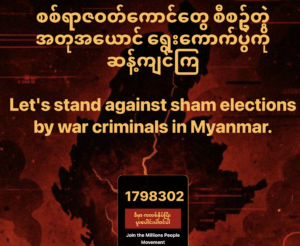
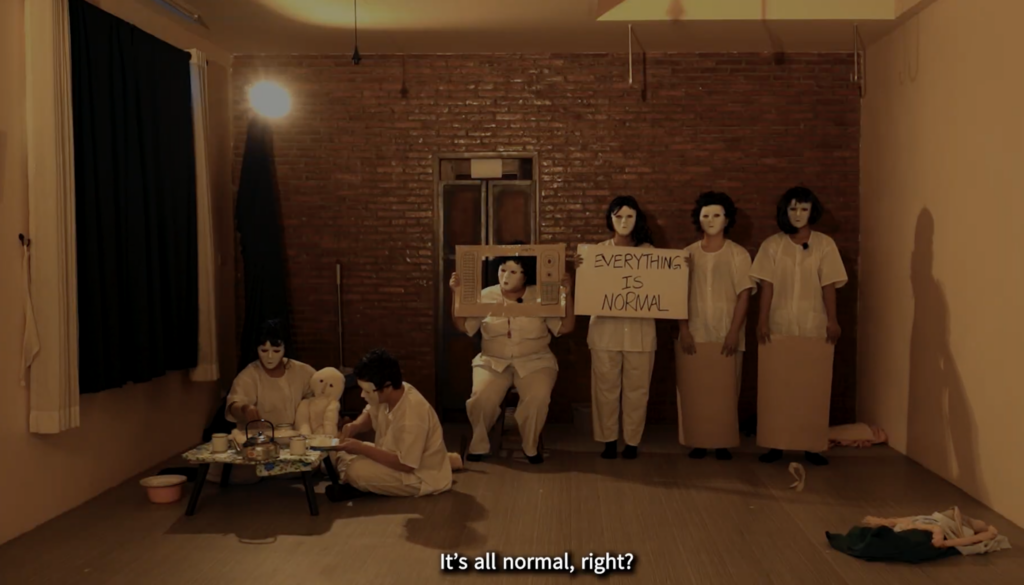
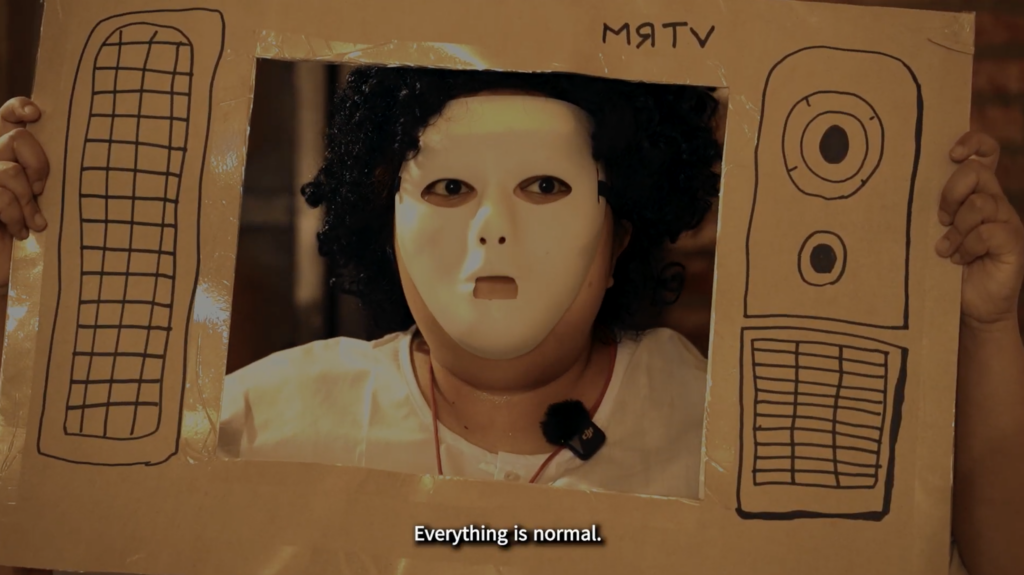
Via the website “No To Sham Elections,” nearly 1.8 million Internet users have expressed outrage at these rigged elections. In the regime-run embassies and consulates, in Taipei or Chiang Mai, the diaspora voted with their feet, by not going, except for families linked to the military. Across Thailand, Rangoon Radio interviewed migrant workers under anonymity. All say that the poll is “utterly meaningless“, “absolutely shouldn’t happen” and will do nothing to address their daily struggles. In the satirical sitcom Safe House Stories , young actors living on the Thai-Myanmar border choose humor and Yangon slang to highlight this popular defiance.
Those who still live in Myanmar find it more difficult to escape the pressure. The Rangoon Scout Network (RSN), which alerts residents to upcoming attacks, explains: “They collected the electoral rolls and posted them on the notice boards of ward administrative offices. Citizens who did not show up at their respective offices to validate their registration received a visit at home. Residents destroyed at least ten election notice boards, but military motorcycles with sidecars are now patrolling the streets to deter sabotage.“
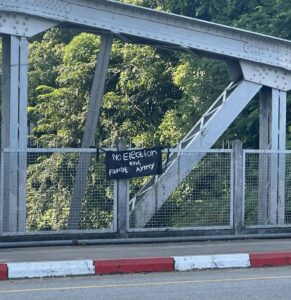
As on every December 10th since the return of the dictatorship, the streets of major cities emptied in a “Silent Strike” to mark International Human Rights Day. A week earlier, a handful of activists led by Dr. Tayzar San, a leading anti-coup figure, organized a flash demonstration in Mandalay, the country’s second-largest city. Those few minutes spent throwing flyers into the air and chanting slogans for “the release of political prisoners, the boycott of elections and the end of forced conscription into the army,” cost one of them his freedom. Htet Myat Aung, a 24-year-old student unionist, was imprisoned under a new draconian law.
Hundreds of people have already been charged for actions on the ground or online criticism under the “Law on the Protection of Multiparty Democratic General Elections from Obstruction, Interference, and Destruction.” The Ministry of Information boasts of having arrested famous artists, but the electoral commission has also admitted that in 56 of the country’s 330 municipalities, it will not be able to organize the election. After five years of what is considered the most fragmented conflict in the world, involving more than 1,200 armed groups, entire regions are beyond central control.
In the coastal state of Rakhine, the Arakan Army (AA) controls the countryside and defends the interests of Buddhist Arakanese, the majority ethnic group. The AA is fighting a fierce battle for complete autonomy in this strategic territory of the Indian subcontinent, which it already administers de facto through the issuance of visas and the establishment of courts. Holed up in Nay Pyi Daw, the junta has only been able to organize elections in three urban centers there. U Myo Kyaw, secretary general of another party campaigning for self-determination, said: “Even in these three districts, the regime has not been able to open polling stations everywhere. No one is interested in the whole thing. Their candidates are having great difficulty campaigning. I don’t know how they will be able to carry out their duties in Parliament or even how they will get there, given that transport has been disrupted throughout the state.”
The political veteran highlights the complexity of the mixed voting system: “All representatives in the lower house will be elected by a First-Past-The-Post system, but for the upper house and regional parliaments, half of the seats will be allocated by proportional representation. The whole confusing electoral process is designed to mislead the public.”
The UN also warns of the risk of using electronic voting machines without the option of casting a blank or invalid vote. These machines, which are limited in number, will travel and record data across the country, which has become a laboratory of authoritarianism in the 21st century. The identification of opponents is also facilitated by an artificial intelligence-based surveillance system at the heart of the military crackdown.
“No one can guarantee their safety,” says U Myo Kyaw of potential dissenters in areas controlled by the regime. “Although voting is legally optional, abstaining is a great risk for people monitored by the regime’s henchmen or living near polling stations,” confirms the scout network.
Ma Ei, a nurse involved in the civil disobedience movement, believes that "the priority is the safety of these people. For those in areas not controlled by the regime, I urge them to oppose this election.” She operates from the central Sagaing region, a hotspot for anti-regime protests, which has been brutalized by daily airstrikes and ground offensives. Since the coup, thousands of residents have lost loved ones - and so many children - lived in darkness, and fled their burned homes.